
“We've got the teamwork to make the dream work. Let's go! Let's go Mets!” ~ Shelly Palmer (1986)
Every Mets fan has their team. “Real ones” will know what I am talking about.
To be initiated into the Mets fan fraternity, there is a team and a season which will drop you to rock bottom in terms of fandom for the first time. It could be due to an epic season-long collapse, one bad finale, an ominous opening day that sets a course a historically embarrassing year, or a front office implosion.

You can’t graduate from recruit status until this experience forces your hand to decide, “is this the life I want to live?”
You can choose to say “this is not for me” and live a happy, carefree life from what I have been told. Or you can be like me. To quote Mets legend Tug McGraw, “ya gotta believe.” Regardless of when you are forced to answer, as an adult or child, this is a lifelong decision/punishment.
My team is the 1998 Amazins. I distinctly remember the confused joy of waking up at a sleepover to learn that they surprisingly acquired superstar slugger Mike Piazza. I also remember this season as the first of many epic collapses in my fandom. They lost the final 5 games of the season to go from safely wild card bound to a one-way off-season ticket. I would have to wait another season to finally see them in the playoffs live for the first time.
There is something both uniquely rewarding and uniquely disappointing about being a Mets fan. The highs are unworldly. This is exemplified by the fact that more people attended the Miracle Mets ticker tape parade in 1969 than the return of the Apollo 11 moon-landing astronauts in the same Canyon of Heroes a few months prior. The cost is that (sometimes-earned) stigma and shame come along with the fandom. Even non-sports fans know that there is always a reason for Mets fans to feel shame, even if that reason can’t be explicitly articulated.
How do we quantify what it means to be a Mets fan? They are not a “bad” team per se. In the past 30 years, they have made two World Series, 7 playoff appearances, and had a couple of players enter the Hall of Fame. It is not like they are not trying either. Even during the cash-strapped Madoff seasons, they were still spending league average in salaries.
So what if someone asks you “what is it like to take the Sisyphean journey every year as a Mets fan?” This requires not just data analysis; it is a self-reflection.
The data can guide the way though. I decided to look at team-by-team records over the past 27 years. 1998 is a great starting point since it is when MLB expanded from 28 to today’s 30 teams. It incorporates both high season-to-season player turnover and increased motivation to win smaller divisions. I only included full seasons, so the 2020 COVID-shortened year was excluded.
Are the Mets bad?
Over the past 27 full seasons, the Mets have averaged 82 wins. An average team (i.e. 50% winning percentage) will win 81 games. This is hardly the record of a bad team. Pirates, Reds, and Rockies fans would love a word if you are convinced the Mets are bad.
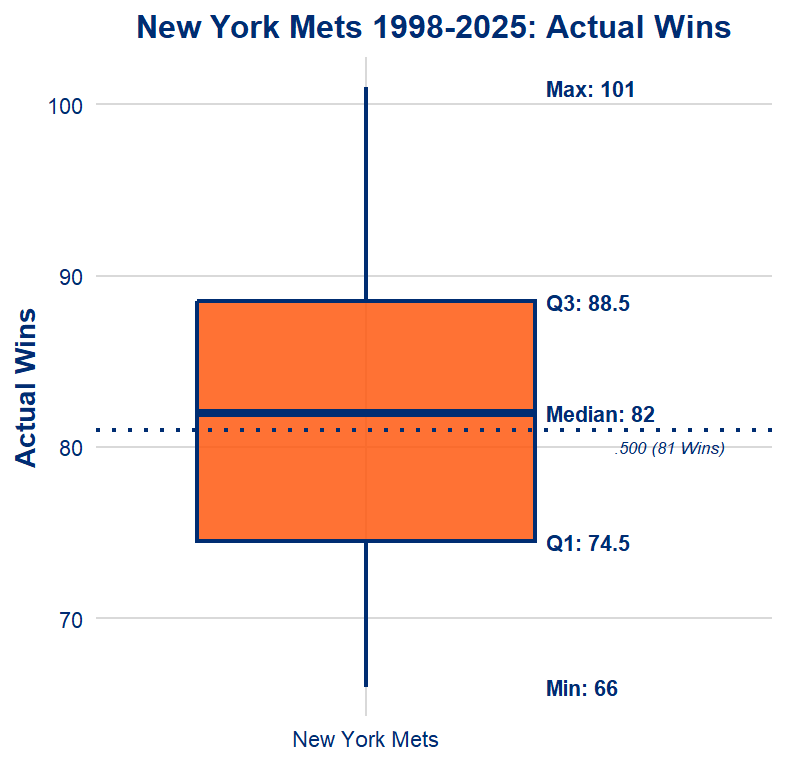
Verdict: Not Bad
Are the Mets good?
The opposite of bad is not “good”; rather, it is “not bad.”
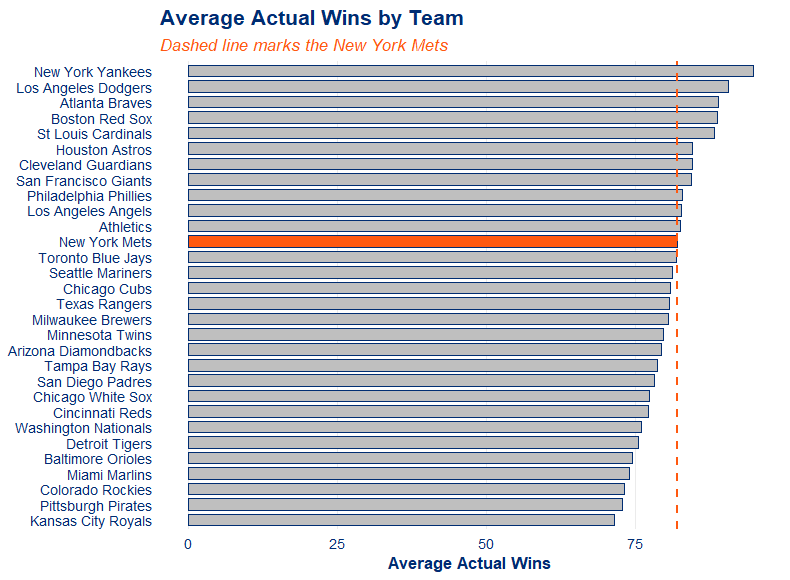
The Mets have the 12th best record in this time period, but upon performing a statistical test to see if their average wins is statistically greater than 81, I found there was no evidence to support the hypothesis (p-value = 0.27) that they are good. Instead, they are one of a handful of teams stuck in mediocrity during this time frame.
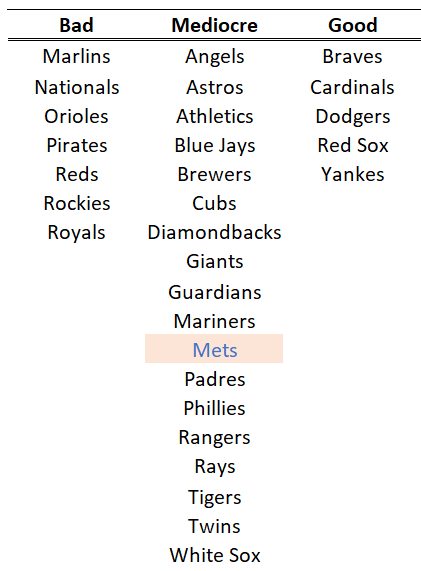
Verdict: Not Good
Are the Mets unlucky?
There is a concept in sports called the Pythagorean Theorem of Expectations. Don’t worry; this has nothing to do with right triangles.
This theorem was formulated by baseball statistician Bill James. His theory is that the amount of runs (or points in other sports) a team scores vs. gives up is actually more indicative of team performance than wins and losses.
Imagine a scenario where we have reached the mid-point of the season, and a team has scored way more runs than it has allowed. Imagine that team also has more losses than wins. The theory is that this team is actually playing better than their record might indicate. Furthermore, this team will be predicted to have a good record in the second half of the season. In practice, this is how the data usually plays out.
What we are interested in is the difference between how many wins a team has at the end of a season and the team’s “true performance”, i.e. Pythagorean wins, i.e. wins predicted based on runs scored and allowed. This difference can be attributed to luck. If a team wins more than its performance might suggest, a team is considered lucky.
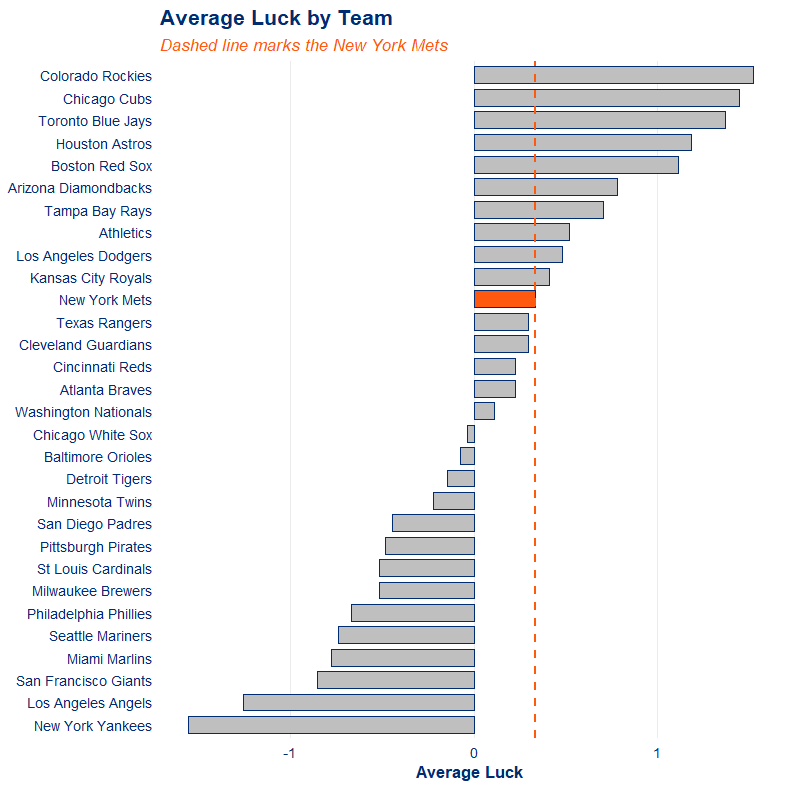
The Mets have averaged 0.33 more wins their record might indicate. An unlucky team would see a strongly negative number. It should be noted that this 0.33 is basically 0 and insubstantial, so the Mets are not lucky either in the long run. Their record on average is justified by their play.
Verdict: Not Unlucky; Not Lucky
So what is it?
I always felt there was something different about being a Mets fan, but, perhaps, we are no different than any other fandom? Our team is not good. Our team is not bad. Our team is not unlucky or lucky. Most fans can say that about their team.
There is one more element I wanted to investigate. Realists might question if they are “systemically disappointing,” while others might ask if they are simply “cursed.” Some might ask if there is a difference.
At the beginning of the season, there is a feeling of hope. For Mets fans, that hope is justified. A really good predictor of how your team will do is betting lines from Las Vegas. Before each year, betting markets create a future wins line essentially designed with a 50% chance that the team will do better and a 50% chance that the team will perform worse by season’s end.
The Mets have had the 6th highest preseason expected wins of all 30 MLB teams. They are supposed to be good.
Vegas is really good at predicting this. Using historical data from covers.com, we can look back at how teams were predicted to perform and how well they did. On average, Vegas has missed by -0.4 wins per team, a gap between prediction and performance that is not statistically different from 0 (p-value = 0.22).
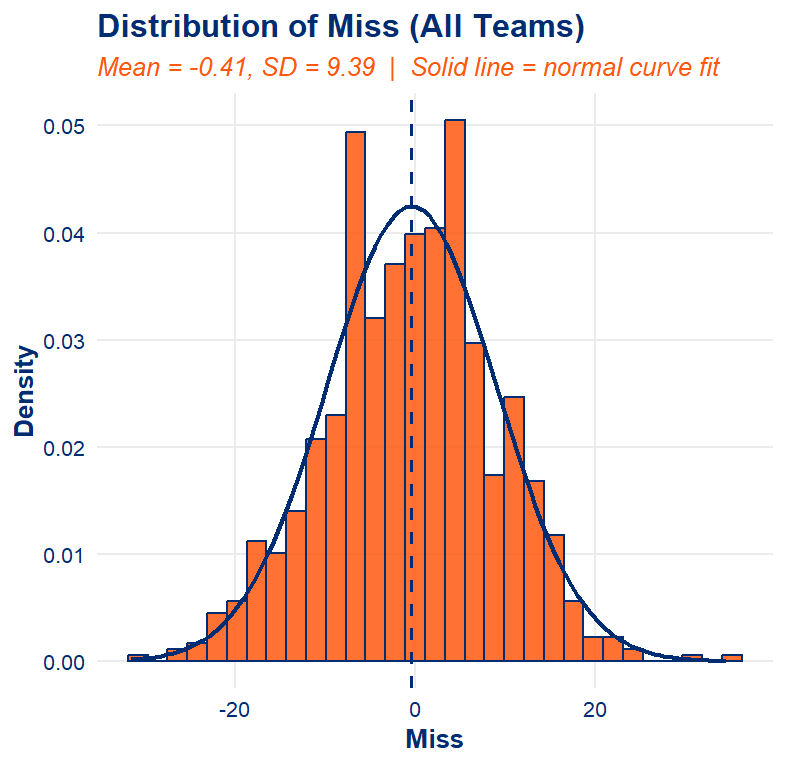
Although it is centered around 0, there are some fairly big misses year-to-year which might be correlated from team to team. When we graph average predicted wins vs. actual wins by team, there is one dot in particular which looks a bit lower than what we might expect.
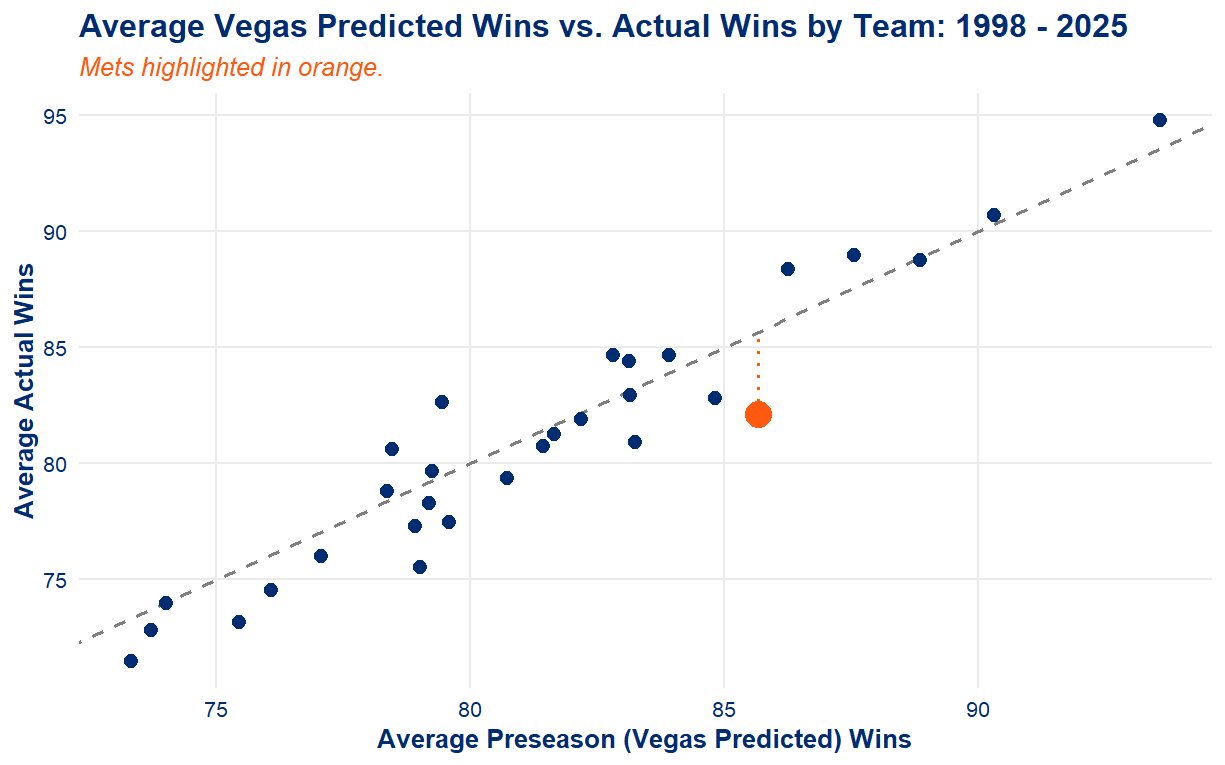
The Mets have the worst differential between their expected wins and actual wins of all 30 MLB teams at 3.55 wins less than expected per season on average. Over the course of 27 seasons, this is nearly 100 fewer wins than expected(!).
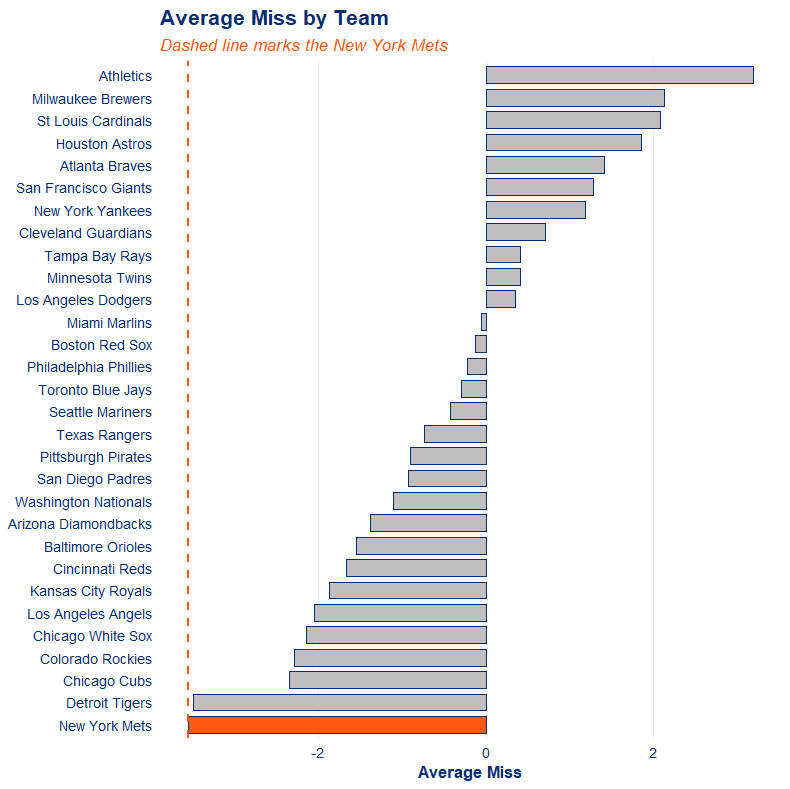
When we include the end of their glorious run in 2026, we will be able to definitively say that this team is either cursed or consistently disappointing.
Verdict: Something is very off here.
So where do we stand?
-3.55 wins each season likely changes the personality of a fandom substantially. Good-bye, Charlie Brown. Hello, SpongeBob.
1998: They would have won the wild card over the Cubs. The playoff narrative which helped Sammy Sosa win MVP over Mark McGwire might not have happened.
2000: They would have won the NL East, stopping the Braves streak at 5 straight NL East titles instead of allowing it to run to 11.
2007: The collapse would have been forgotten.
2008: Another collapse would have been erased from history.
2019: This really fun upstart team, one of my favorites not to have made the playoffs, could have been immortalized with a playoff appearance.
2020: The playoff party, which seemingly included most teams, would have included the Mets.
2022: The Mets would have punched their ticket to the Division Round after not completing the collapse to the Braves.
2025: The collapse would have been a footnote, meaning perhaps the 2026 team would still have Alonso and Nimmo.
The difference between bad luck and cursed is that bad luck implies unpredictability. As evidenced in my Mets text groups, when the Mets started to slide last summer despite having one of the best winning percentages at that time, we all knew where the team would stand by fall.
What is worse is that I can’t tell you the cause of this effect as to reverse any sort of hex. Perhaps they are being punished for the greed of the Giants and Dodgers leaving town nearly 70 years ago? Perhaps they used up all goodwill to win the miraculous 1969 and 1986 World Series? Maybe there is something in the marshy waters of Flushing?
Despite all this, 2027 is definitely the Year of the Mets. #LGM
Ya gotta believe,
Adam from 2xParked
I think another factor to consider is that the Mets are almost always among the biggest payrolls in the league. That sets the tone for expectations (although perhaps some of that is factored into the Vegas preseason bets).