2xParked #65
An AI Guide to the Primaries

Happy Parade Morning!
It feels like a non-stop parade this spring. We had the Israel Day Parade on May 31, Puerto Rico Day last Sunday, and NYC Pride coming up on the 28th. This doesn’t even include the impromptu parades after each Knicks victory.

If you happen to be one of the over 1 million participants in the celebrations today, there is a high probability you’ll have a great view of the back of the head of some dude 3–6 inches taller than you.
That means you will be staring at your phone a lot. As you try to edge around, you might as well be thinking about your next stop when the parade ends: the early voting polls. Make a plan!
It has been another loud campaign season, especially for several seats in Congress. With Knicks mania, the World Cup, and the world feeling like it's perpetually falling apart, it's understandable if you're one of the many who ignored the constant mailers or Instagram ads. Despite acknowledging the existence and the annoyance of the ads1, it still feels like the primary snuck up on me, so I consider myself one of those folk catching up before voting.
To help us out, I recruited my good friend Claude Opus 4.8:
Get Topics of Discussion: I first used the Spring 2026 Yale Youth Poll to narrow down potential generic topics of interest for voters.
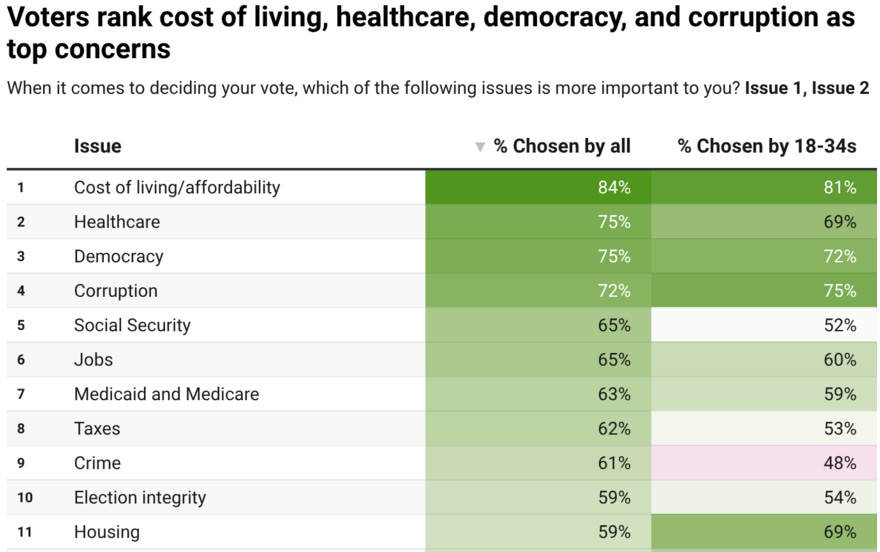
Gather the Data: I copied and pasted all of the issues, platforms, and policy suggestions of each candidate in a competitive primary into their own document.
Ask Claude:
Hello, Claude. I am a voter in New York City.
I will paste information regarding the candidate’s priority and plan from their website. Provide one to five words to describe whether they have a plan in place to accomplish their goals.
I also want you to help me answer questions on the following topics. Please indicate if what is presented is actually a good idea, and provide 1-2 reasons why. (Note: please do not say what you think I want to hear. I am ok with hearing a candidate I like who has a bad plan or a candidate I don’t like who has a good plan).Affordability: What will you do to make everyday life more affordable?
Healthcare: How would you make healthcare work better for people?
Democracy: How would you strengthen trust in our democracy?
Corruption: How will you keep government honest and accountable?
Jobs: What’s your plan to create good jobs?
Housing: How would you make housing more affordable?
Since many of you may not be voting in any of these districts, the rest of this article will be extremely boring. I'll start with my final parting conversation with Claude after I received my answers. It's what I found to be the most interesting part of this exercise, so I didn't want to leave it for the end where it might be ignored.
Me: “Thanks, Claude. If you could sum up all our candidates, does NYC have the representation it needs in Congress? Be honest.”
Claude: “The picture across all these candidates is that NYC has passionate, well-intentioned people running, with genuine track records in some cases. But there are two structural problems that cut across almost all of them.
First, the gap between aspiration and mechanism is wide. Nearly every candidate supports Medicare for All, a federal jobs guarantee, and major housing investment — all of which require a Democratic trifecta that doesn’t currently exist and may not exist after November. Almost none of them have a credible answer for what they actually do in the meantime as a minority-party freshman member.
Second, the candidates with the most detailed, realistic plans — Bores on tech and housing math, Goldman on specific legislation already filed, Lasher on state-level track record, Lander on housing finance — tend to be running in the more competitive or higher-profile races. The candidates with the broadest, most transformative visions tend to have the thinnest mechanisms.
What NYC genuinely lacks in this field is a candidate who combines two things at once: a real legislative track record and a specific near-term agenda that doesn’t depend entirely on a Democratic majority.
The talent is real. The ambition is real. The translation from campaign platform to congressional effectiveness is where the honest gap lies.
Well. It has happened; AI is taking over. I could not have said it any better myself.
For now…🥁🥁🥁…I present the 2xParked AI Guide to Voting in the Democratic Primaries (in alphabetical order by district).
Enjoy!
Adam from 2xParked
NY-7
Antonio Reynoso
Claude says…
Strong record, but platform is underdeveloped.
Affordability: Mixed idea. “Tax the rich and close loopholes” is a real mechanism with genuine merit, but beyond that the plan is vague — no specific tax rates, no spending
Healthcare: Good idea in principle, weak on path. Medicare for All would genuinely solve the coverage and cost problems he describes, and his maternal health track record is concrete and impressive. The systemic overhaul has no realistic near-term congressional path, making it aspirational rather than actionable.
Democracy: Not addressed. A notable gap.
Corruption: Not addressed. Also a notable gap, though his mention of overturning Citizens United gestures in this direction without a real plan.
Jobs: Good idea, thin on specifics. PRO Act support, NLRB strengthening, and reining in gig misclassification are well-grounded and backed by real labor experience. However, there’s no jobs-creation mechanism here — it’s worker protection, not job generation.
Housing: Good idea, incomplete. Repealing Faircloth, expanding rental assistance, and cracking down on Wall Street speculators are sound and specific. The plan is notably thinner than his other issues — for someone who grew up in Section 8 housing and has been Borough President, this section is surprisingly underdeveloped.
Claire Valdez
Claude says…
Ambitious progressive platform, few concrete mechanisms.
Affordability: Mixed idea. A federal electricity rate freeze and federal jobs guarantee are bold and targeted at real pain points, but a rate freeze risks discouraging utility investment and is very hard to sustain long-term; economists are divided on whether job guarantees are workable at scale.
Healthcare: Good idea in principle, weak on path. Medicare for All would genuinely eliminate the coverage gaps and cost-rationing she describes, and the evidence for its efficiency is real. However it requires dismantling a massive private industry and has no realistic near-term congressional path, so it functions more as a values statement than a plan.
Democracy: Not addressed. This is a significant gap in her platform as presented.
Corruption: Not addressed. Also a notable gap; there’s no anti-corruption or ethics agenda in these materials.
Jobs: Strong and specific. A federal jobs guarantee, PRO Act, end to at-will employment, prevailing wage enforcement, and a 32-hour workweek are concrete, well-articulated proposals — this is her most developed area. The 32-hour week has growing evidence behind it, though a federal jobs guarantee is economically contested and administratively complex.
Housing: Strong and detailed, with one real controversy. National rent control, social housing construction, repealing Faircloth, and tenant opportunity to purchase are specific and coherent. However, most mainstream economists argue that broad rent control reduces housing supply over time — she acknowledges this tension but doesn’t resolve it.
Julie Won
Claude says…
Strong on housing; thin everywhere else.
Affordability: Not addressed directly. Her “Lifetime of Care” framing gestures at it, and internet-as-utility and housing affordability touch the edges, but there’s no explicit affordability or cost-of-living agenda in these materials.
Healthcare: Not addressed directly. She mentions healthcare access in her vision statement but provides no healthcare policy platform in what was provided — a significant gap for a congressional candidate.
Democracy: Not addressed. No voting rights, election integrity, or democratic reform agenda present.
Corruption: Not addressed. No ethics or anti-corruption platform present.
Jobs: Not addressed directly. There are workforce development mentions in housing and tech sections, but no labor or jobs agenda was included.
Housing: Good idea, credible track record. Repealing Faircloth, fully funding NYCHA, expanding rental assistance, and cutting permitting delays are sound and specific, and she has a genuine local record — 32,000 units built with 12,000 affordable — that backs it up. First-time homebuyer credits are demand-side and can push prices up, which is the one weak spot.
NY-10
Dan Goldman
Claude says…
Concrete bills filed; needs Democratic majority.
Affordability: Partly good idea. Reversing Trump’s tariffs is one of the most direct, evidence-backed ways to lower consumer prices, and the ROBINHOOD Act targets a real.
Healthcare: Mixed. His targeted, achievable bills are genuinely strong: permanently funding the 9/11 health program and doubling long-term mental-health beds for Medicaid recipients address concrete gaps. Medicare for All is the headline but has no realistic path and would be hugely disruptive to finance, so it functions as aspiration rather than plan.
Democracy: Good idea. Early voting, same-day registration, and an anti-gerrymandering ban are well-tested reforms that measurably expand participation and reduce district manipulation. One caution: legislatively “forbidding political prosecutions” by DOJ is well-intentioned but constitutionally tricky, since it brushes against executive prosecutorial discretion.
Corruption: Strong idea, most credible area. The congressional stock-trading ban and closing the “gratuity” loophole (a response to the 2024 Snyder ruling that narrowed bribery law) target real, documented conflicts of interest. He also has an actual track record here — he filed the complaint that led to expelling George Santos — so this isn’t just promises.
Jobs: Solid on standards, thin on creation. The PRO Act and universal paid leave are concrete pro-worker measures with real support. But like his opponent, this is worker-protection, not job-creation; and a $17 federal minimum wage, while defensible in high-cost areas, has more contested employment effects in low-cost regions, and “protect workers from AI layoffs” lacks any actual mechanism.
Housing: Mostly good, one weak spot. Expanding the Low-Income Housing Tax Credit is among the most proven federal tools for building affordable units, and junk-fee crackdowns help renters directly. The weak spot: first-time homebuyer credits are widely criticized by economists as demand-side subsidies that can push prices up without adding supply — so that piece may backfire on affordability.
Brad Lander
Claude says…
Mostly contingent on Democratic majorities.
Affordability: Mixed. Relies on a federal wealth tax to fund child care, M4A, and housing, plus gig-worker wage protections; the labor pieces are concrete, but the wealth tax has never passed Congress and faces real constitutional and enforcement hurdles.
Healthcare: Reasonable and honest. Medicare for All is the long-term goal, but he’s upfront that the achievable near-term work is restoring ACA subsidies and reversing Medicaid cuts.
Democracy: Specific but contingent. Names real voting-rights bills (John Lewis Act, Freedom to Vote Act) plus Supreme Court expansion and term limits; nearly all require a Democratic trifecta, and court expansion is contested even among Democrats.
Corruption: Strong idea, most credible area. The congressional stock-trading ban and closing the “gratuity” loophole (a response to the 2024 Snyder ruling that narrowed bribery law) target real, documented conflicts of interest. He also has an actual track record here — he filed the complaint that led to expelling George Santos — so this isn’t just promises.
Jobs: Solid but narrow. The PRO Act and federal versions of his NYC gig-worker laws are concrete, but it’s more about improving and unionizing existing jobs than creating new ones.
Housing: Strong and detailed. “Social Bonds for Social Housing,” repealing Faircloth, 70,000 homelessness vouchers, and zoning reform — grounded in programs he actually ran.
NY-12
Alex Bores
Claude says…
Most technically specific platform; still needs Democratic majority.
Affordability: Good idea, most specific of any candidate. Banning junk fees, reforming AMI calculations for affordable housing eligibility, a national reinsurance stabilization fund to lower insurance premiums, and a tariff refund for affected families are unusually concrete and mechanically specific. The junk fee and AMI reforms have real state-level track records behind them.
Healthcare: Mixed. Medicare for All is the headline but faces the usual no-realistic-path problem; the near-term pieces — drug price negotiation, capping insulin costs, restoring NIH funding — are more actionable and grounded in his state legislative record.
Democracy: Good idea, specific and credible. Congressional stock trading ban, Supreme Court term limits with an enforceable ethics code, DOJ independence legislation, and a constitutional amendment restricting self-pardons are concrete and address documented real problems. His state-level record passing AI deepfake election protections adds credibility.
Corruption: Strong, with personal accountability. Refuses all corporate PAC money (allows only union PACs), supports overturning Citizens United, and has specific legislation targeting insider trading and pardon abuse. One of the more credible anti-corruption platforms of any candidate reviewed.
Jobs: Thin. The “AI Dividend” taxing large AI labs to distribute returns to workers is an interesting idea but untested and politically very difficult. The Green New Deal jobs framing is real but vague on mechanism. This is the weakest section given his tech background.
Housing: Good idea, technically sophisticated. Fixing the AMI formula is a genuinely underappreciated problem that most candidates ignore — “affordable” units built to the wrong income benchmark don’t actually house the people who need them. Repealing Faircloth, using federal land, and streamlining NEPA are sound and specific. Land speculation tax is creative and evidence-backed.
George Conway
Missing. His website sucked. I will give you bonus points if you can find what he stands for on his campaign website.
Micah Lasher
Claude says…
Strongest state-level record; needs Democratic majority for most.
Affordability: Good idea, credible track record. Raising the minimum wage and indexing it to inflation, expanding child care investment, and housing tax credits are concrete and evidence-backed — and he’s actually done the minimum wage indexing at the state level, which strengthens the claim. Child care expansion is well-supported by research on economic participation.
Healthcare: Mixed. Medicare for All or “a similar universal plan” is notably hedged — the flexibility is honest but vague, and neither path has a realistic near-term congressional route. Strengthening ACA subsidies and reversing Medicaid cuts are the more actionable near-term pieces.
Democracy: Good idea, specific. The For the People Act, John Lewis Voting Rights Act, and the Protecting Our Democracy Act are concrete named bills targeting real documented problems. His record of actually writing state-level democratic safeguards gives this more credibility than most.
Corruption: Good idea, with personal accountability. A congressional stock-trading ban, codifying the Emoluments Clauses, and refusing corporate PAC money are specific and he’s bound himself to the last one personally. His state-level record of anti-corruption legislation backs this up.
Jobs: Solid but narrow. PRO Act support and minimum wage indexing are concrete and evidence-supported. The platform is worker-protection focused rather than job-creation focused, and there’s no manufacturing, green jobs, or broader economic development agenda present.
Housing: Good idea, credible. Expanding housing tax credits, rental assistance, and leveraging federal dollars to push pro-housing zoning reform are sound and he helped enact a $4.5 billion state affordable housing program. First-time homebuyer credits are a weak spot as they can inflate prices without adding supply.
Jack Schlossberg
Claude says…
Centrist, achievable goals; missing majority to pass most
Affordability: Mixed, moderate and honest. Rolling back tariffs, raising the minimum wage, repealing the SALT cap, and a standard rent deduction are concrete and targeted. The SALT cap repeal disproportionately benefits higher-income homeowners, which is at odds with his working-family framing, and is one of the more honest tell-signs of the district he’s running in.
Healthcare: Good idea, honest about sequencing. Supporting a public option rather than M4A outright is politically more realistic and he’s candid that it’s a step toward universal care rather than pretending M4A will pass. Extending ACA subsidies and expanding drug price negotiations are achievable near-term goals.
Democracy: Good idea, specific. Nonpartisan redistricting commissions, disclosure requirements for political donations, and a congressional stock trading ban are concrete and well-supported by evidence. He also personally rejects corporate PAC money, which backs up the rhetoric.
Corruption: Solid, credible. Stock trading ban, lobbying reform, and foreign influence restrictions are specific and he’s bound himself personally by rejecting corporate PAC money. Less ambitious than some candidates but more achievable.
Jobs: Reasonable, standard. PRO Act, prevailing wage, paid family leave, and job training programs are solid mainstream labor positions. Nothing innovative, but all evidence-backed and concrete enough to be meaningful.
Housing: Mixed. Investing in public housing, reducing regulatory barriers, and permitting reform are sound. The rent deduction is a demand-side subsidy that could push rents up without adding supply, and SALT repeal helps higher-income homeowners more than renters — the two weakest pieces in an otherwise reasonable platform.
NY-13
Darializa Avila Chevalier
Claude says…
Day 1 bill list is specific; needs Democratic majority for nearly all of it.
Affordability: Good idea, specific mechanisms. Child tax credits, baby bonds, baby boxes, universal basic income, and a $15 minimum wage are concrete and target real cost burdens. UBI at the federal level has no realistic near-term path, but the child support pieces (credits, savings accounts) are evidence-backed and have prior legislative precedent.
Healthcare: Good idea in principle, same path problem. Medicare for All including dental, vision, reproductive care, and gender-affirming care is the most expansive version reviewed. The financing mechanism and political feasibility remain the core unresolved challenges, though the Day 1 co-sponsorship commitment is more binding than most candidates’ general support.
Democracy: Good idea, specific. Banning super PACs, prohibiting congressional stock trading, breaking up monopolies, and criminalizing price gouging are concrete. She personally refuses corporate PAC money, which backs up the rhetoric. The price gouging criminalization is contested among economists but addresses a real public concern.
Corruption: Strong personal commitment, backed by specific policy. Refuses corporate PACs, supports banning super PACs and congressional stock trading, and proposes breaking up tech monopolies. Among the more credible anti-corruption stances reviewed.
Jobs: Strong and specific. Federal jobs guarantee, PRO Act, 32-hour workweek, fully funded NLRB, and ensuring federal contracts don’t go to union-busting companies are all concrete. The 32-hour workweek has growing evidence behind it; the jobs guarantee is contested but real.
Housing: Good idea, coherent package. 5% annual rent cap for large landlords, fully funding NYCHA, Section 8 expansion, community land trusts, and national tenant protections are specific and form a coherent supply-and-protection strategy. The rent cap is better targeted than blanket national rent control.
Adriano Espaillat
Claude says…
Strong local record; platform is mostly backward-looking.
Affordability: Partial, track record over agenda. Securing NYCHA funding, protecting tenants at Lakeview, the Second Avenue Subway funding, and Hurricane Maria recovery grants are real, documented deliverables. However, this is a record of housing and infrastructure wins rather than a broader cost-of-living agenda — there’s nothing on food costs, childcare, wages, or everyday expenses beyond housing.
Healthcare: Not addressed. A significant gap for an incumbent’s platform.
Democracy: Partial, credible track record. Backing Trump impeachment early, the JARED Act blocking security clearances for presidential family members, and Epstein document transparency are concrete actions. But there’s no broader democracy reform agenda — no voting rights bills, no campaign finance reform, no stock trading ban mentioned.
Corruption: Thin but real. The JARED Act is a specific, concrete anti-nepotism measure. Otherwise the corruption agenda is limited to oversight and accountability framing without named legislative mechanisms.
Jobs: Not addressed. A notable gap.
Housing: Good idea, with a genuine track record. Securing $7.7 billion for Phase 2 of the Second Avenue Subway, protecting Lakeview Apartments tenants, and fighting Inwood rezoning in court are real, documented deliverables — this is his strongest area and backed by actual results rather than promises.
Breaking News: Scientific Breakthrough?! They might be the remedy for the social media problem. I was off Instagram the most during the last few weeks to avoid all the ads.